
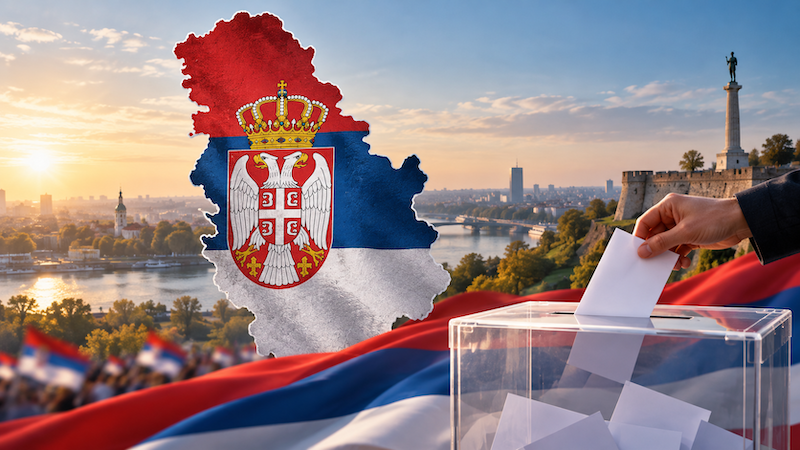
An extraordinary election victory in Serbia has shown how ordinary citizens can challenge entrenched political power and change their country’s future.
Sixteen lives lost. Nearly two years of protests. A generation demanding change. Then came an election that transformed Serbian politics. On Sunday, 25 October 2026, a student-led movement achieved something that had seemed almost unimaginable: defeating the political machine of Aleksandar Vučić, the man who had dominated Serbia for more than a decade.
The Student List, a new electoral movement born from university protests, secured a parliamentary majority according to preliminary results, ending 14 years of government led by Vučić’s Serbian Progressive Party (SNS). But perhaps the most remarkable story was not simply who won. It was how thousands of previously politically disengaged citizens helped make it happen.
A tragedy that sparked a revolution
The story began on 1 November 2024 when a concrete canopy collapsed at the railway station in Novi Sad, Serbia’s second-largest city. Sixteen people died in the disaster, a tragedy that triggered widespread public anger over allegations of corruption, inadequate oversight and failures in public infrastructure projects.
For many Serbians the tragedy became a symbol of broader problems within a political system they believed had become increasingly unaccountable. University students began organising demonstrations, demanding that those responsible be held accountable and that documents relating to the station’s renovation be made public.
What began as a campaign for justice developed into something much larger. Protesters accused the government of corruption, political interference in institutions and increasingly authoritarian practices. Vučić and his allies rejected accusations of systemic wrongdoing and maintained that opponents were attempting to destabilise the country.
Yet the protests continued.
Students occupied university buildings, organised road blockades and staged mass demonstrations. Their demands expanded from accountability for the disaster to fundamental institutional reforms. In January 2025 Prime Minister Miloš Vučević resigned amid mounting unrest, following attacks on protesting students… but even that failed to end the movement.
From university campuses to national movement
What distinguished Serbia’s student uprising was its ability to reach far beyond university lecture halls. Students organised marches and bicycle journeys between cities and towns, sometimes travelling considerable distances to connect with communities outside the major urban centres. Their campaign attracted support from teachers, farmers, doctors, academics, workers and pensioners.
Rather than relying on a single charismatic political leader, the movement developed a largely decentralised structure, with students making decisions through assemblies and collective discussions. This was particularly important in a country where established opposition parties had struggled to challenge the governing SNS.
The students represented a fresh political force, largely unconnected to traditional party rivalries. Their message focused on accountability, functioning institutions, corruption and the rule of law. As demonstrations continued through 2025 and into 2026, the movement developed a nationwide network of supporters.
Serbia had witnessed massive protests before, including those that helped end Slobodan Milošević’s rule in 2000. But this generation was demonstrating that political activism could extend beyond demonstrations into the institutions of government themselves.
From protesters to politicians
The movement’s most consequential decision was to contest national elections. After months of public mobilisation it created an electoral platform known as Student List – Students Win. Strictly speaking, it was not simply a newly registered student political party. Rather, it was a citizen-backed electoral list bringing together candidates from a range of professions.
On 14 September 2026, supporters marched through Belgrade to submit their candidates and the signatures needed for registration. The movement collected approximately 70,000 verified supporting signatures, comfortably exceeding the legal requirement of 10,000. Its list contained 250 candidates, including professors, medical professionals, activists and other citizens with limited previous political experience. It was headed by Ilija Srđanović, a cardiologist and university professor from Novi Sad.
The campaign emphasised rebuilding public institutions, confronting corruption and restoring public confidence in government. Meanwhile, Vučić’s SNS campaigned on its record of economic development, infrastructure investment and stability.
Vučić had served as prime minister and then president since 2014. In September 2026, he resigned the presidency to lead his party’s parliamentary campaign, potentially returning to government as prime minister. The contest was therefore about much more than an ordinary change of government. It had become a test of whether Serbia’s established political order could withstand a new generation of challengers.
The election that changed Serbia
The outcome on 25 October was historic. According to preliminary figures released by Serbia’s Republic Electoral Commission on 26 October, with more than 96% of polling stations counted, the Student List had secured approximately 52.5% of the vote, compared with 39.3% for Vučić’s coalition.
Vučić conceded defeat, estimating that the student-backed movement would win between 135 and 140 seats in the 250-member parliament, well above the 126 required for a majority.
However, the most striking figure was the turnout, as approximately 69% of eligible voters participated, the highest turnout in Serbia since the breakup of Yugoslavia in 1992. People queued outside polling stations as an unusually large proportion of the electorate exercised its democratic rights. When Vučić acknowledged defeat, celebrations erupted across Belgrade and other Serbian cities. Thousands filled the streets, waving flags, singing and cheering.
The demonstrations that had begun in anger and grief had culminated in victory at the ballot box. One of the movement’s representatives, university professor Radomir Šajčić, captured the moment: “Tonight we celebrate victory, tomorrow we build the future.”
The extraordinary power of voting
Serbia’s election offers an important lesson for democracies everywhere. Political change can appear impossible when one party has controlled government for years, particularly when opposition movements are fragmented and citizens have lost confidence in established institutions.
But political dominance does not necessarily mean electoral permanence. Serbia’s students did not achieve their breakthrough overnight. It required nearly two years of organising, campaigning, building relationships and maintaining public attention. Crucially, the movement converted its popularity on the streets into votes.
Without that final step, even the largest demonstrations would not necessarily have produced a parliamentary majority. The election also highlights the importance of participation. A record turnout helped produce a result dramatically different from the parliamentary elections of 2023, when the SNS-led coalition won 129 seats.
Of course, winning an election is only the beginning. The Student List must now establish a functioning government and confront the difficult realities of public administration, economic policy, political compromise and institutional reform. Its promises will ultimately be judged by what it delivers, not simply by the enthusiasm surrounding its victory.
Nor does any election guarantee that every citizen will be satisfied with the outcome, but Serbia has demonstrated something fundamental about representative democracy: established political power can be challenged and changed through elections. For citizens who have become cynical about politics, the events of October 2026 provide a striking example of what sustained civic engagement can accomplish.
The students organised. Communities joined them. Millions participated in the election. And the political landscape changed. The lesson extends far beyond Serbia: voting cannot guarantee the result any individual wants, but collective participation can change who governs and what becomes politically possible.
Sources: