
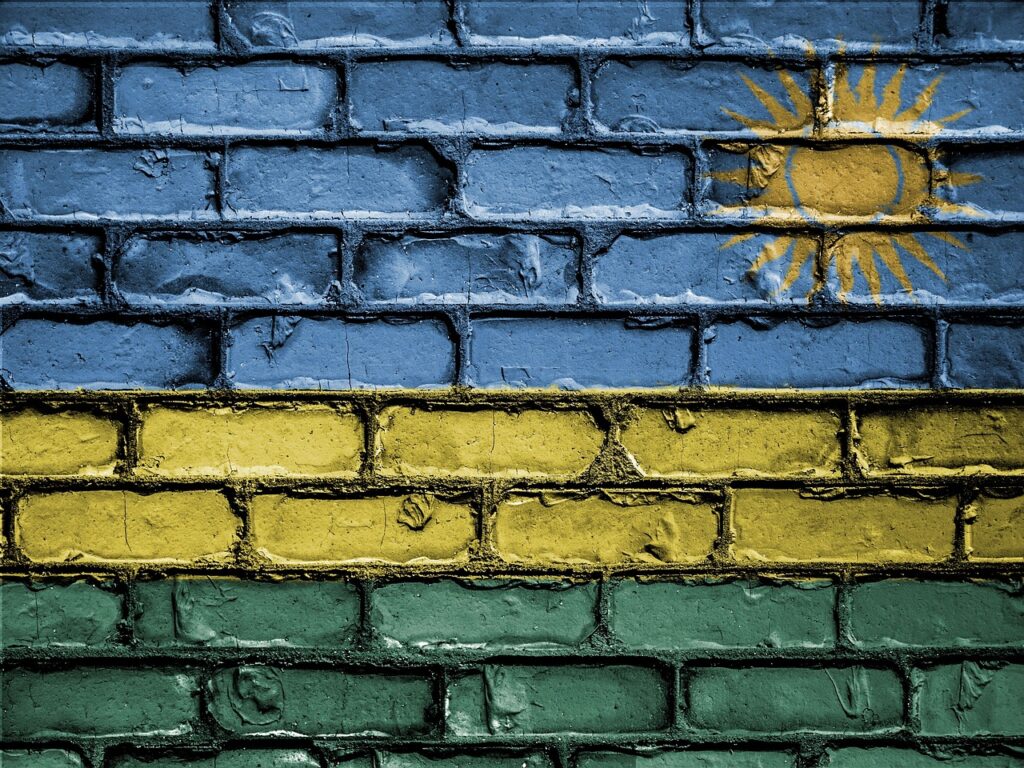
The 4th of July is Liberation Day in Rwanda as it commemorates the end of the horrific genocide of Tutsis by Hutus during the Rwandan Civil War. Sadly it wasn’t the end of the killing in the region, writes Simon Lewis.
When the Rwandan government-owned Dassault Falcon 50 corporate jet was approaching its final descent to Kigali International Airport in Rwanda on 6 April 1994 it had on board a high-ranking delegation including Rwandan President Juvénal Habyarimana and the leader of neighbouring Burundi, President Cyprien Ntaryamira. The two presidents were returning with their entourages from a regional peace summit in Dar es Salaam, Tanzania. As the plane banked to prepare for its final descent, an unknown military group launched a volley of surface-to-air missiles at the plane.
One missile crashed into a wing of the descending Falcon and moments later a second missile exploded into the plane’s tail, which burst into flames mid-air. The Falcon plummeted to earth, ironically crashing into the garden of the presidential palace, where it exploded on impact, sealing the fates of the three French crew, seven passengers and two presidents.
The double assassination was the catalyst for one of the bloodiest and most chilling series of events of the late 20th century: the Rwandan genocide.
While the group responsible for the presidential assassination is still not known to this day, at the time sectors of Rwanda’s majority Hutu population blamed the Tutsi minority for the attack. Tensions rose rapidly and it didn’t take long for calls to start ringing out inciting Hutus to kill Tutsi men and women. What followed was a chilling 100 days of mass slaughter of Rwandan Tutsis that resulted in an estimated 500,000 to 800,000 Tutsi civilians being murdered. This was internationally recognised as a genocide as the killing resulted in over 60% of Tutsis in Rwanda losing their lives. Many were gunned down, but the killing extended to the gruesome hacking to death of Tutsi civilians with machetes.
The carnage included over 250,000 Tutsi women being raped, with some estimates suggesting that the number could have been as high as half a million. The Hutu attacks were so intense that many of the Tutsi victims were slaughtered in their own villages and towns by Hutus who were the neighbours of their victims. Many Tutsi were found hiding in churches and schools, where they were then massacred.
The genocide received enormous coverage in the global media, with much criticism being levelled at the international community for not stepping in sooner to end the violence. There is, however, a very important lesson to be learned from this genocide as it follows a trend that can be seen in a number of previous conflicts and even current conflicts. Revenge genocide.
If you mention the word Rwanda to most people around the world they will know that there was an horrific period of Rwandans being shot as well as hacked to death, but few know what happened after the end of the Civil War: the revenge genocide. There’s a well known saying that goes, “to the victor the spoils”, meaning that whoever wins a conflict will benefit from whatever power, territory or mineral wealth the defeated party had to offer.
What we don’t hear much about is the violence that results due to the extreme anger that follows many bloody conflicts, in particular when the party that had been attacked ends up as the victor.
The Tutsi-dominated Rwandan Patriotic Front (RPF) rebel group seized power in Rwanda on the 4th of July, in so doing bringing an end to the genocide. Fearing reprisals, over one million Hutus fled to Zaire.
While this genocide served as one of the most terrible blights of the 20th century, the sad reality is that it was a long time coming and was the result of numerous bloody conflicts in the region. From around the 15th century Rwanda had been a centralized, absolute monarchy ruled at times by Tutsi kings. Tutsis were the minority of Rwanda’s population while the Hutus were the majority, making up around 80% of the population. The Tutsis were a wealthy, elite ruling class. They owned land and cattle while Hutus worked on the land and paid taxes to their Tutsi masters.
In 1959 there was a revolution in Rwanda which resulted in the Tutsi monarchy being overthrown in 1961, with the Hutus seizing power and Rwanda being declared a republic.
With the far-right Parmehutu Hutu supremacist party coming to power in 1962, around 300,000 Tutsis fled the country fearing for their lives. These refugees fled to Uganda and Burundi but later attempted to invade Rwanda, only to be defeated by the new Rwandan government’s armed forces in 1963, with between 10,000 to 20,000 Tutsis being massacred between 1963 and 1964. There followed almost two decades of relative peace until the outbreak of the Rwandan Civil War in 1990, which culminated in the 100-day genocide in 1994 that saw the slaughter of between 500,000 to 800,000 Tutsis.
Two years after the conflict had ended the Tutsis embarked on what could be labelled a revenge genocide during the First Congo War (1996-1997). The Rwandan-backed rebel group AFDL (The Alliance of Democratic Forces for the Liberation of Congo) and the Tutsi-headed Rwandan army massacred 200,000 Hutu refugees in Zaire (now the Congo). AFDL soldiers and Rwandan Army soldiers hunted down fleeing refugees, attacked refugee camps and massacred civilians, including women and children. According to Human Rights Watch and the United Nations Human Rights Office, Hutu refugees were shot dead, killed with machetes, knives, bayonets, hatchets, hammers and hoes, with some civilians also being burned alive.
In the subsequent Second Congo War, between 2.6- to 5.4-million people were killed in what some claim to be the deadliest conflict since World War II and the decades-long Chinese Civil War. While ‘only’ around 350,000 people died in actual violent conflict in the Second Congo War, the majority of the many millions of fatalities were caused by the disease and malnutrition that resulted from the conflict and the disruptions to civilian life, the economy and agricultural production.
While these deaths weren’t the direct result of the conflict, it would have been expected that there would be massive civilian casualties due to the conflict and, hence, it could be considered a genocide as per Point 5 of Article II of the United Nations’ international definition of what constitutes a genocide: “Deliberately inflicting on the group conditions of life calculated to bring about its physical destruction in whole or in part”.
These casualties were similar to the 600,000 to 2.1-million ethnic German civilians who died between 1945 and 1950, which could by the United Nations’ definition arguably also be considered a genocide and which, by implication, would also make it a “revenge genocide”.
Hitler committed a genocide against millions of Slavs and then the Slavs committed genocide against Germans, but the reality is that, as in Rwanda, the greatest suffering was inflicted on a civilian population that was effectively blameless for the conflicts.
A total of 6.98-million Germans were also deported from the parts of Germany that were annexed by Poland in 1945. During these mass deportations of Germans from Poland, Russia, Czechoslovakia and other countries, between 600,000 to 2.1 million ethnic German civilians perished due to malnutrition, illness suffered due to the freezing cold conditions in which they were travelling, and from life in internment camps where they were subjected to harsh forced labour.
These were not people guilty of war crimes, they were German civilians and, even if they had voted Hitler into power, the fact that they were targeted after the war is clear evidence that it was an act of revenge. The authorities would have known that a large number of these individuals would die due to the conditions of their deportations, in addition to the hundreds of thousands of German civilians who were imprisoned in the internment camps. To all intents and purposes those deaths also bear the hallmark of a revenge genocide.
There are many other examples of small-scale revenge genocide attacks, such as by Yugoslavia on Italians at the end of World War II, which included the killing of suspected Yugoslav collaborators. Other instances occurred in Kosovo as well as in Israel and Palestine, and even Burundi saw the slaughter of Hutus in the 70s and the Tutsis in the 90s which, given their ongoing conflicts at the time, could also be labelled as a form of revenge genocide. The common denominator is the innocent civilians who pay the price for the madness and cruelty of their military leaders.
The term genocide is naturally highly emotive and, as such, the international community has recognised just three major historical events as “genocides”: the Holocaust (1941–1945), the Rwanda Genocide (1994) and the Srebrenica massacre in Bosnia (1995), although there is broader recognition that there was a genocide in the Armenian, Herero, Darfur and Cambodian conflicts, as well as the Rohingya Crisis in Myanmar and the ongoing conflicts in Gaza. While the term revenge genocide might never become widely used, it is important to raise it in the public consciousness because it exposes the brutal truth behind war, conflict and the effect on innocent civilian populations.
So while Rwandans celebrate Liberation Day on the 4th of July, it is important to remember that it was not the end of the tragic killings of civilians in the region. However, it should also remind combatants that, even when war is supposedly over, the massacring of innocent civilians might still continue as angry and vengeful survivors seek retribution. And, sadly, as can be seen in Rwanda, that cycle often keeps going around and around in an endless spiral of violence.
The sad reality is that war doesn’t end when one side wins or loses, and the only thing more tragic and devastating to a nation and its people than a genocide is the revenge genocide that can shatter the long-awaited peace that a nation’s civilians would have been desperate to achieve.
Simon Lewis is a Cape Town-based writer and editor whose work covers business, history, sport and public affairs. He is the former editor of Leadership magazine in South Africa.
Photo: David Peterson/Pixabay